Research
If you're deciding whether to trust our work, start here. We measure every figure in these papers against an outside reference you can look up: Stockfish 19, a top open source chess engine, for Mate; the published math for audio filters for Ruse; the Apple TV's clock for Room; and three tape formulations for Bias Tape. Each paper also tells you where the product falls short.

Ruse: audio plugins built from blocks, with gates
Brian M. Gilmore, Symbia Labs
In music software, a plugin that crashes takes the whole recording session down with it, and runaway feedback can blast the speakers at full volume. When an AI agent writes the plugin and nobody reads the code, the framework has to catch those faults. Ruse, our MIT-licensed Rust framework, builds every plugin from fifteen tested signal-processing (DSP) blocks and won't package one until seven automated checks, which the paper calls gates, pass. We checked the DSP against the textbook math (closed-form references) and against independent re-implementations. Six claims hold only in part, and one filter misses its documented corner frequency by 3 dB at 5 kHz.
- 7Gates every plugin passes before packaging, each tested against a probe built to fail it
- 281 of 281Tests that don't need macOS, passing on x86_64 Linux
- +382 dBFSRunaway feedback the gates caught in the case study, which a listen at the default settings would miss
- 3 dBMiss at the one-pole high-pass's documented corner at 5 kHz, one of the defects listed
Mate: a legible chess engine that tutors
Brian M. Gilmore, Symbia Labs
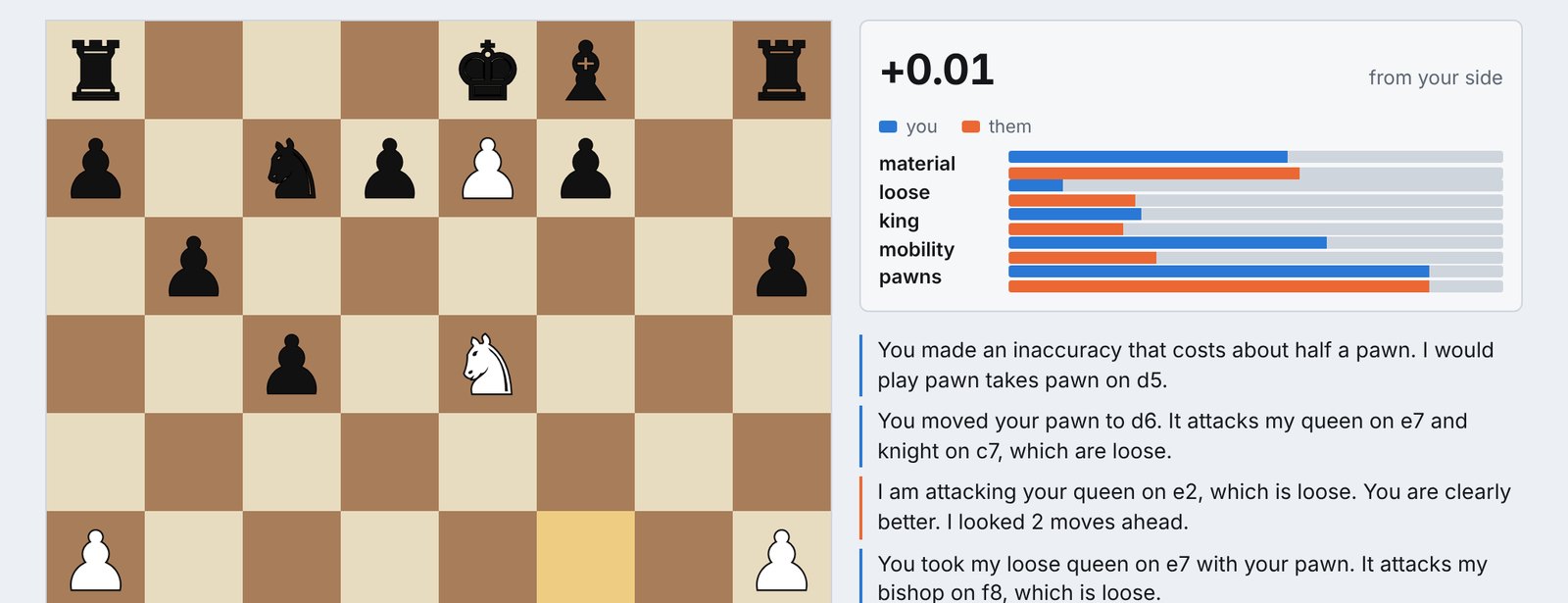
Strong chess engines such as Stockfish and Leela score positions with neural networks, so their numbers are accurate and hard to explain to a player. Mate, our chess engine, explains itself to a club player. It builds every score from five named parts, material, loose pieces, king exposure, mobility and pawn structure, and breaks each score down into numbers for each side. Fixed templates write the game chat with no language model involved, and an independent checker built on python-chess, a standard chess library, tests every sentence against the position. By the paper's own account, the biggest gap is that most grades don't yet say why a move was bad.
- 1870 ± 80Rating on Stockfish's UCI_Elo scale at 10 s + 0.1 s
- 0 of 922False claims in its sentences about the opponent's moves
- 94%Moves graded the same at depth 5 as at depth 6
- 129 of 136Games won against people on Lichess, rated 685 to 2203

Room: measuring the listening room
Brian M. Gilmore, Symbia Labs
Home theater room correction measures sound at the listening seat, so it can't tell you what to move or where acoustic treatment belongs. Room, our measurement app, maps the room's shape along with its sound. The depth sensor (LiDAR) on an iPhone or iPad Pro records the room, your position and the audio as you walk, while Room View on an Apple TV plays music through your own system on a clock the phone follows. The paper covers placement only. Setting the receiver's level, EQ and delay from Room's measurements isn't built yet.
- about 1 inSpeaker position
- ±10°Direction each speaker points
- about 2 msPhone and Mac against the Apple TV's clock
- 84 msFixed latency through HDMI and the receiver

Bias Tape: a multitrack tape machine model
Brian M. Gilmore, Symbia Labs
Recording software that imitates analog tape usually runs a separate tape machine on every track, each with its own speed error. Bias Tape, the tape model inside our Bias app for TASCAM Model mixers, treats the whole session as one tape recorder with one transport and one set of heads. The tracks drift together, and each picks up its neighbors at the level the tape format's track width sets. Every track runs a physical model of tape magnetization (Jiles–Atherton), standard record and playback equalization and playback-head losses in real time. The paper's processing-cost claim failed by 3%, on a computer that was compiling two applications during the run.
- 22Tracks at once on the Model 2400
- 0.2 dBFrom the target level for 3% third-harmonic distortion, three tape formulations
- 0.62%Of real time per mono channel, M-series laptop
- 3Predictions that broke, all reported